5 Common SaaS Outreach Mistakes and AI Solutions
Avoid five common SaaS outreach mistakes—generic messages, poor targeting, early pitches, unchecked automation, and skipped follow-ups—use AI for personalization and lead scoring.
 Julien Gadea
- Generic Messages: 87% of LinkedIn requests lack personalization, leading to low acceptance rates. AI tools like SalesMind AI can craft tailored messages in seconds, boosting open rates by 82%.
- Targeting the Wrong Prospects: Poor targeting wastes resources. AI-driven lead scoring filters high-value prospects, increasing efficiency and reducing churn.
- Pitching Too Early: Hard sales pitches too soon turn prospects off. Multi-step outreach sequences, focusing on value first, can raise reply rates from 9% to 27%.
- Unchecked Automation: Automated messages without oversight risk spam flags and brand damage. Combine AI with human review for quality control.
- Skipping Follow-Ups: Nearly half of salespeople don’t follow up, yet 80% of sales need 5+ touchpoints. AI automates follow-ups and optimizes timing, saving time and improving conversions.
Quick Takeaway:
AI tools like SalesMind AI help scale outreach without losing personalization. By avoiding these mistakes, you can improve engagement, save time, and close more deals.
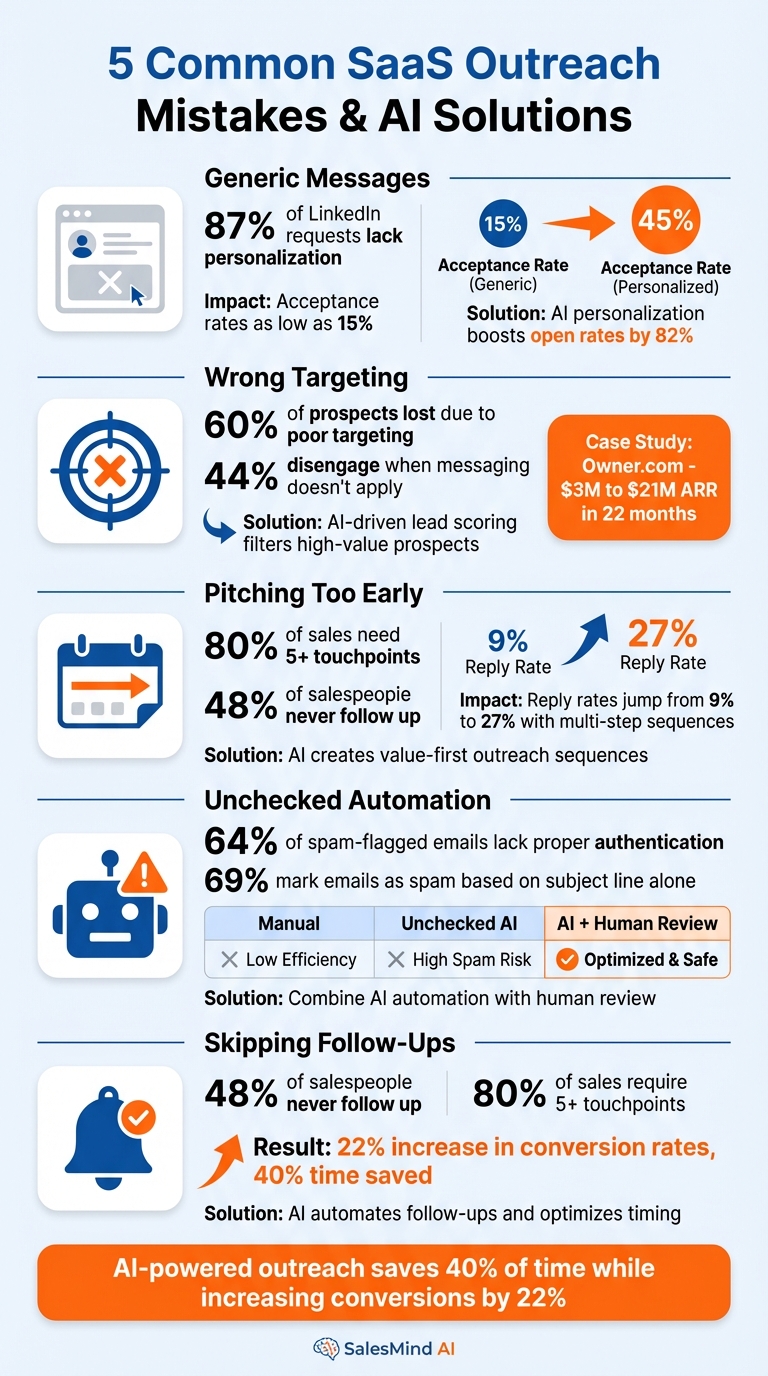
5 Common SaaS Outreach Mistakes: Key Statistics and AI Solutions
Mistake 1: Sending Generic Messages on LinkedIn
Why Generic Messages Miss the Mark
Did you know that 87% of LinkedIn connection requests are sent without any personalization? [3] When someone receives a cookie-cutter message, it’s easy for them to spot that it’s part of a mass outreach campaign. This lack of effort signals that the sender hasn’t taken the time to understand their recipient’s unique challenges or goals. The result? Many of these requests are ignored - or worse, flagged as spam [1].
The numbers speak for themselves: generic connection requests have acceptance rates as low as 15%. On the other hand, personalized messages can boost that rate to 45%, a threefold improvement [3]. Beyond acceptance rates, sending impersonal messages can tarnish your brand’s image, making your outreach blend into the sea of uninspired LinkedIn messages. If you want to stand out, you need to make your approach personal, and tools like AI can help you do just that.
"I try to get as personalized as possible right out of the gate to catch their eye. This takes an extra minute or two for research, but it is worth it if I can increase my open and response rates." – Giuliana LaRose, Business Development Representative, Lusha [1]
Using AI to Craft Personalized Outreach
Researching prospects manually can take up to 20 minutes per account, but AI tools can handle this task in seconds. By pulling data from sources like financial reports, social media profiles, and news articles, AI platforms can create highly tailored messages without the time drain [4].
SalesMind AI, for example, follows a proven 300-character formula: 50 characters for a hook, 100 for context, 100 for value, and 50 for a soft call-to-action [3]. This structure ensures your message is concise yet impactful, referencing specifics like job titles, recent achievements, or shared connections. The result? You can send over 1,000 personalized messages daily, with open rates that are 82% higher than those of generic templates [1].
sbb-itb-817c6a5
Mistake 2: Targeting the Wrong Prospects
The Cost of Reaching the Wrong People
When you target the wrong audience, you're not just wasting time - you're burning through resources. Research shows that 60% of prospects are lost because of poor targeting, and 44% disengage when they feel the messaging doesn’t apply to them [10]. This inefficiency clogs your pipeline, increases acquisition costs, and leads to higher churn rates. Imagine your sales reps spending hours researching accounts that aren’t a good fit or AEs chasing deals that were doomed from the start. The result? A team stretched thin and customers who cancel their subscriptions within months, quietly draining your revenue.
Take Owner.com as an example. Between 2022 and 2024, they refined their ideal customer profile using a machine-learning score called "Expected GMV." This allowed them to pinpoint high-value customers, skyrocketing their ARR from $3M to $21M in just 22 months. At the same time, they managed to lower acquisition costs and boost retention [5]. Similarly, CastorDoc narrowed their target account list from 36,000 to just 3,000 by focusing on companies already using a "modern data stack." This approach saved resources by avoiding prospects still tied to outdated systems who weren’t ready for their product [5].
To avoid these pitfalls, leveraging AI can help you score and filter leads with unmatched accuracy, ensuring your team connects with the prospects who truly matter.
Using AI to Score and Filter Leads
AI takes the guesswork out of lead scoring, replacing hunches with data-backed insights. Instead of relying on static rules or intuition, AI evaluates thousands of signals, such as firmographics (like company size, revenue, and industry), technographics (tools and technology in use), behavioral data (e.g., website visits, email interactions), and trends from your most successful customers [7][8]. Each prospect gets an objective conversion probability score, which updates in real time as new data comes in.
Platforms like SalesMind AI push this even further by automating account research and data enrichment. They analyze LinkedIn profiles, company websites, and public records to identify prospects that perfectly match your ideal customer profile. The system also tracks buying signals - like recent funding, leadership changes, or new hires - that suggest a company might be in the market for your solution [8]. For instance, in February 2025, the B2B lead-generation agency Belkins dramatically reduced their email bounce rate from 19% to just 0.4% by implementing real-time list validation. This improvement in lead quality boosted their email deliverability and significantly increased their ROI on outreach campaigns [1].
AI also helps weed out low-intent leads. Negative scoring filters out prospects who provide fake information or immediately unsubscribe, so your team can focus exclusively on engaged, high-potential opportunities [11].
Mistake 3: Pitching Products Too Early
Why SaaS Buyers Want Value Before Sales Pitches
Once you've identified the right prospects, the next step is to engage them in a way that prioritizes value over an immediate sales pitch. Think about it - prospects are bombarded with messages daily. Emails or LinkedIn DMs that jump straight to a demo request or an appointment are often ignored without a second thought [12][2]. Leading with a hard pitch right after connecting can make the interaction feel transactional, not conversational. Even personalized outreach doesn’t give you a free pass to dive into selling right away. Prospects tend to push back against offers, even if the initial message feels tailored to them.
What do B2B buyers actually want? Useful, relevant information. Sharing things like industry trends, free tools, or peer benchmarks helps establish trust and builds a sense of reciprocity. This approach makes them far more open to hearing about your solution later on [3]. As sales trainer Zig Ziglar famously said:
"Every sale has five basic obstacles: no need, no money, no hurry, no desire, no trust" [6].
Pitching too soon forces you to tackle all these objections at once - and that’s a tough hill to climb. The numbers back this up: 80% of sales require at least five follow-ups, yet nearly half of salespeople give up after just one attempt. On the flip side, sequences with four to seven touches see reply rates jump from 9% to 27% [1]. This highlights the importance of a value-first, multi-step outreach strategy.
Creating multi-step LinkedIn message sequences with AI
Timing your pitch is just as crucial as personalizing your message. AI tools can help by taking the guesswork out of the research phase. These tools scan LinkedIn activity, public filings, and social media feeds to identify key trigger events - things like funding announcements, leadership changes, or significant hires. This allows you to craft messages that are not only personalized but also contextually relevant. Instead of opening with, "Can I show you a demo?" you could reference a recent company milestone and share a case study that aligns with their priorities.
Platforms like SalesMind AI make it easier to implement multi-step outreach strategies that focus on building trust before introducing a sales offer. Here’s an example of a 17-day sequence the platform might automate:
- Day 0: A thank-you message to establish rapport.
- Day 4: Share a helpful resource, like a report or article.
- Day 10: A soft introduction to your product or service.
- Day 17: Present a tailored value proposition [3].
The platform also tracks engagement signals - like profile views or content interactions - to help you identify the right moment to shift from relationship-building to a business conversation.
Multi-step sequences don’t just keep prospects engaged - they also ensure your outreach feels natural and respectful. For instance, SalesMind AI schedules follow-ups on Tuesdays and Thursdays between 9:00 AM and 12:00 PM in the recipient’s time zone, optimizing for higher engagement rates [1]. Instead of aggressive calls-to-action, these sequences use softer prompts like, "Worth a chat?" or "Want me to send over a quick overview?" [12]. This approach keeps the tone conversational, respects the prospect’s decision-making process, and ensures your solution stays on their radar when they’re ready to make a move.
Mistake 4: Automating Without Quality Control
Problems with Unchecked Automation
Automation can supercharge your outreach efforts, but if left unchecked, it can create serious problems. Without proper oversight, AI-generated messages can come across as robotic and miss critical context, which can harm your brand reputation.
The most obvious risk is brand damage. Generic, impersonal messages can make your company seem careless. Worse, if an AI tool pulls outdated or incorrect data - like referencing a prospect's old job title or a milestone that never happened - it not only reduces response rates but also tarnishes your professional image. Another big issue? Spam flags. A surprising 64% of B2B emails flagged as spam lack proper authentication, and 69% of recipients mark emails as spam based solely on the subject line [1]. Automation without oversight can easily fall into these traps, hurting your email deliverability rates.
Here's a quick comparison of different approaches to outreach quality control:
| Aspect | Manual Outreach | Unchecked AI Automation | AI with Human Review |
|---|---|---|---|
| Speed | Slow/Manual | Near-instant/High volume | Scalable/Efficient |
| Personalization | High (but hard to scale) | Surface-level/Generic | Deep/Context-aware |
| Risk | Low (human error) | High (spam flags, brand damage) | Low (guardrails in place) |
| Consistency | Hard to maintain | High (but robotic) | High (on-brand) |
In the world of SaaS sales, prioritizing volume over trust is a losing game.
Combining AI Automation with Human Review
To avoid these pitfalls, the solution is to combine AI efficiency with human judgment. As Evermethod, Inc. explains:
"AI isn't here to replace salespeople. It's here to remove the manual, repetitive work so humans can focus on building trust and relationships" [2].
Take SalesMind AI as an example. The platform automates tasks like prospect research and drafting messages but includes a layer of human review. This ensures every message reflects your brand’s voice and is tailored to the recipient's specific context. It's a perfect balance of technology and human insight, reinforcing the importance of personalized and context-sensitive outreach.
Start with strong content governance. Assemble a small team - three to five people from sales, marketing, and RevOps - to review AI-generated messages weekly. This group can identify successful tones, flag off-brand content, and refine messaging strategies [4]. For high-value leads, like C-suite executives or prospects involved in sensitive events (e.g., acquisitions or leadership transitions), always require manual review [4].
For larger campaigns, implement weekly spot-checks on random samples of messages to ensure quality remains consistent [4]. This proactive step helps catch small issues before they snowball. And the results speak for themselves: personalized emails can boost click-through rates by 14%, while timely follow-ups can increase reply rates by 49% [9]. But these benefits only materialize when your messages feel genuine, not mass-produced.
Mistake 5: Skipping Follow-Ups and Data Analysis
Why Follow-Ups Matter in SaaS Sales
Here’s a surprising stat: nearly 48% of salespeople never follow up after their initial contact. Yet, 80% of sales require at least five touchpoints to close [13][1]. That gap represents a massive amount of missed opportunities.
In SaaS sales, prospects often need multiple interactions before making a decision. Their busy schedules and timing conflicts mean a single email or call just won’t cut it. Follow-ups aren’t just about persistence - they’re about keeping the conversation alive in a meaningful way. Whether it’s sharing a case study that directly addresses their challenges, highlighting a recent milestone, or tackling a pain point they mentioned earlier, follow-ups should feel like a natural extension of your initial outreach, not a desperate attempt to grab their attention.
Automating Follow-Ups and Tracking Performance with AI
Staying on top of follow-ups can be overwhelming, but AI tools make it easier to manage. They tackle two major hurdles: keeping follow-up schedules consistent and using data to fine-tune your outreach. Take SalesMind AI, for example - it automates follow-up sequences and LinkedIn sales automation while tailoring messages to each prospect. By analyzing engagement signals like email opens and link clicks, it adjusts the timing and content of follow-ups dynamically, rather than sticking to a rigid schedule.
Timing is everything. Your first follow-up should go out about three days after the initial contact - ideally on a Tuesday or Thursday between 9:00 AM and 12:00 PM in the recipient’s local time zone [1]. To avoid spam filters and maintain your sender reputation, limit your sequence to two or three follow-up emails [1]. Tracking metrics like email open rates at each touchpoint can help you pinpoint where prospects lose interest [14]. With AI automating repetitive tasks like scheduling and data entry, you can save up to 40% of your time and focus on closing deals [1].
Cold Outreach Mistakes: How to Fix and Avoid
Conclusion
Addressing common SaaS outreach mistakes is entirely possible with the right mix of AI-powered and personalized strategies. The five pitfalls we discussed - sending generic messages, targeting the wrong prospects, pitching too early, automating without proper checks, and neglecting follow-ups - can all be corrected. Tools like SalesMind AI tackle these issues by blending automation with smart personalization and actionable data insights.
With these adjustments, AI-powered lead scoring ensures you’re focusing on the prospects that matter most. Automated sequences help maintain consistent outreach while keeping the quality intact. The payoff? Better engagement, higher response rates, and more deals closed.
The numbers back this up. AI-driven follow-up sequences have been shown to increase conversion rates by up to 22% [1]. Additionally, teams using AI automation save 40% more time [1]. These are clear advantages in a competitive market.
FAQs
How does AI enhance personalization in SaaS sales outreach?
AI is changing the game for SaaS sales outreach by enabling highly personalized messaging on a massive scale. By analyzing data such as funding announcements, job transitions, and previous interactions, it pinpoints relevant details for each prospect. This makes outreach not only more engaging but also far more tailored - something that would be almost impossible to achieve manually.
These tools also excel at drafting and refining outreach messages through natural language generation. From crafting compelling subject lines to writing opening sentences and value propositions, AI ensures the tone, industry, and role of the prospect are taken into account. Features like real-time lead scoring and automated follow-ups add another layer of precision, ensuring communication is timely and contextually relevant. This means businesses can connect with the right prospects more effectively.
Take tools like SalesMind AI, for example. They allow SaaS teams to automate LinkedIn outreach, customize messaging, and qualify leads - all while maintaining a personal touch. It’s a way to deliver one-on-one engagement without losing efficiency or scalability.
What are the advantages of using AI for lead scoring?
AI-powered lead scoring takes the guesswork out of identifying top prospects, allowing sales teams to zero in on the most promising opportunities. By analyzing data, it highlights high-value leads, helping you prioritize efforts where they matter most. The result? Less wasted time and higher conversion rates.
On top of that, AI can detect potential roadblocks in your sales pipeline early on. This gives your team the chance to address challenges head-on and speed up the deal-closing process. With this data-driven approach, your outreach becomes more strategic, delivering stronger results.
Why is it important to combine AI automation with human judgment in sales outreach?
Combining the speed of AI automation with the nuance of human judgment strikes a balance between efficiency and personalization. While AI can analyze data, craft customized messages, and manage follow-ups at scale, it often falls short in understanding the finer details of context, tone, or compliance - areas where sales professionals excel. Without human input, automated outreach risks coming across as impersonal or even misaligned, potentially damaging trust and engagement.
A quick human review can fine-tune AI-generated content, ensuring messages connect with prospects and align with your overall strategy. This hybrid method boosts response rates, weeds out low-quality leads, and frees up sales teams to focus on high-value activities like relationship-building and closing deals. SalesMind AI exemplifies this approach by automating LinkedIn outreach and lead scoring while equipping sales reps with tools to personalize and review interactions. The result? A seamless blend of AI-driven efficiency and human insight for stronger outcomes.
Additional Resources
Quikr AI , an AI-driven SEO optimization company based in Dublin, Ohio, has announced the launch of its groundbreaking 90-Day AI SEO Growth Guarantee Program. This new initiative aims to help businesses with established WordPress websites achieve measurable improvements in their search engine optimization within just three months. The program is tailored for companies with domains that are at least six months old, ensuring a solid foundation for growth.
While terms and conditions apply, the company is confident in its ability to deliver results through its advanced AI-powered system. Focused Approach for WordPress Websites The 90-Day AI SEO Growth Guarantee Program specifically targets WordPress websites with aged domains, leveraging their existing search engine trust signals. Businesses in highly competitive markets, including Columbus and Cleveland in Ohio, are among the primary beneficiaries. The program is designed to enhance search rankings, drive traffic, and increase qualified leads.
"AI has transformed the future of search", said a Quikr AI spokesperson. "Our 90-day growth guarantee reflects our ability to combine machine learning, automation, and data-driven SEO strategies. Companies in Ohio’s competitive markets, including Columbus and Cleveland, can now trust Quikr AI to deliver results faster than traditional agencies." Proven Success Stories Quikr AI highlights its accomplishments through verified client success stories, showcasing how its AI-powered solutions have delivered significant improvements in SEO performance and lead generation.
One example is a campaign in partnership with an appliance repair company. By overhauling their digital strategy, Quikr AI achieved: An 80%+ boost in click-through rates (CTR) through optimized Google Ads . A 93% increase in organic clicks and a 107% rise in impressions. A 181.9% improvement in conversions after revamping the company's landing pages and user flow. Another notable case involved a hair braiding business, where Quikr AI focused on local SEO and Google Business Profile (GBP) enhancements.
This resulted in: A 222% jump in phone calls from their GBP. An 88% peak growth in profile interactions, with sustained growth at 44% over subsequent months. These examples demonstrate the program’s ability to deliver impactful results for businesses in diverse industries, both locally and nationally. Expanding Service Areas Quikr AI’s optimization program is available in Columbus and Cleveland, Ohio, as well as to eligible businesses across the United States.
By offering nationwide consulting for companies that meet the program’s requirements, Quikr AI continues to position itself as a trusted leader in AI-driven SEO. Why Businesses Choose Quikr AI Quikr AI’s services stand out in a crowded marketplace due to its cutting-edge approach. Key features include: AI SEO Optimization : Utilizing advanced machine learning algorithms to improve Google rankings. WordPress SEO Services : Custom campaigns tailored for the world’s most popular content management system.
Local and Entity SEO : Strategies that drive real-world traffic, calls, and clicks. Full Digital Strategy : Expertise in web development, social media management, paid advertising, and CRM solutions. The company has also built a strong reputation backed by key metrics: a 4.9+ average rating from verified client reviews, 1,200+ satisfied clients across more than 20 industries, and $5 million in annual ad spend management. Program Eligibility and Requirements The program is designed for businesses ready to leverage AI-powered SEO to achieve tangible results.
To qualify, participants must meet the following criteria: WordPress Website : The program is optimized for businesses using WordPress. Domain Age : A minimum of six months is required to ensure a solid foundation. Commitment to Growth : Participants must be dedicated to improving rankings and scaling visibility. Openness to AI : Businesses must be willing to adopt machine learning and semantic SEO techniques. Terms & Conditions : Transparent rules are in place to ensure consistency and fairness.
By setting these requirements, Quikr AI ensures that participating businesses are well-positioned for success. About Quikr AI Founded in 2023 and headquartered in Dublin, Ohio, Quikr AI specializes in AI-driven SEO, web development, social media marketing, CRM solutions, and paid ad management. The company serves a wide range of clients across major cities like Buffalo, NYC, Cleveland, and Columbus, delivering measurable growth through its innovative, data-backed strategies.
With its new 90-day guarantee program, Quikr AI continues to redefine expectations for SEO optimization, helping businesses achieve faster and more reliable results in today’s competitive digital landscape. For more information, Quikr AI can be reached via its main office in Buffalo, New York.
 JG
JG